
Anderson County Court Records After Arrest
The arrest-to-court path has three separate records in Anderson County. The first is the booking record in the ACSO or city detention system. The second is the warrant or charging paperwork that can appear in a roster hold reason or a court record. The third is the formal court case in the South Carolina Judicial Branch and Anderson County Public Index after filing. The jail roster charge is not a conviction, and ACSO's own disclaimer says suspects are presumed innocent until proven guilty.
For custody and booking details, use the Anderson County jail inmate records page. For booking photos, use the Anderson County jail mugshots page. Court records after a jail arrest are different because they track the filed charge, status, hearings, disposition, bond history, and whether the case moved through magistrate, municipal, or General Sessions court.
Find Court Records After Arrest
The official court search route is the South Carolina Judicial Branch case-record search and the Anderson County Public Index. Public Index is separate from the jail roster. It is the better source for filed charges, hearings, dispositions, sentencing, case numbers, and case status after an Anderson County arrest.
- Start with the jail roster and copy the full name, arrest date, warrant number, statute code, charge text, and bond judge when shown.
- Search Anderson County Public Index by defendant name. Add case number, warrant number, court, or date range if results are too broad.
- Compare the roster charge with the court charge. The formal case may show amended, reduced, dismissed, indicted, or final charges.
- Read the case status and disposition instead of assuming the booking charge is the outcome.
- If no case appears yet, check again later or contact the clerk or court that issued the warrant.
The manifest image for the Anderson County Public Index shows the official court-search page used for case records after arrest.
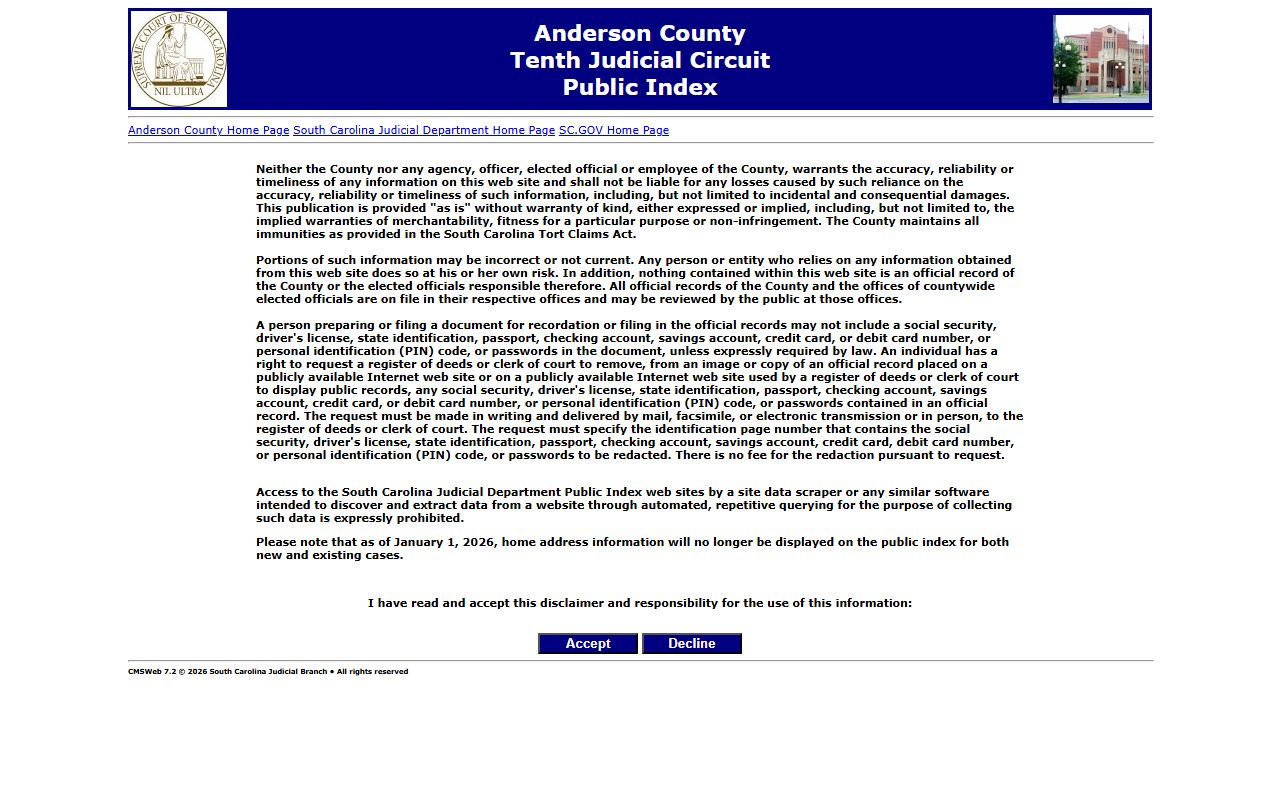
That portal is where court filings and docket status should be checked after the jail booking stage.
Anderson County Court Search Fields
The exact field labels can vary by court module, but the research found the standard Anderson Public Index search path built around case number, party name, court, case type, and filed date. A name search is easiest, yet a case number or warrant number can prevent false matches when a common name appears.
| Field Label | Type | Required | Notes |
|---|---|---|---|
| Case Number | Text | Optional | Best when known from warrant or court paperwork. |
| Party Name | Text | Optional | Search by defendant last and first name; spelling matters. |
| Court Agency / Court | Dropdown | Optional | Use Anderson County courts or a specific magistrate or General Sessions court when known. |
| Case Type | Dropdown | Optional | Criminal, traffic, magistrate, civil, or other module choices may appear. |
| Date Filed / Date Range | Date | Optional | Narrows older or common-name searches. |
| Search / Reset | Buttons | Not applicable | Runs or clears the query. |
Charges After an Anderson County Arrest
South Carolina uses Solicitors rather than District Attorneys. Anderson County is in the Tenth Judicial Circuit Solicitor's Office, which serves Anderson and Oconee Counties. The Solicitor handles many General Sessions prosecutions after arrest. Lower-level municipal and magistrate charges may stay in those courts, while felony-level matters can move through General Sessions, indictment, plea, trial, or other disposition.
The Solicitor's role explains why a jail charge may not match the final court record. A roster can list a warrant charge or statute code at booking. The prosecutor may later pursue that charge, reduce it, amend it, dismiss it, or present it to a grand jury. For case status, search Public Index. For prosecution office information, use the Tenth Judicial Circuit Solicitor.
Charging Documents After Arrest
Different papers can move a case from arrest to court. A complaint may begin a lower-level case or support a warrant. An information can be filed by the prosecutor in some criminal matters. An indictment is a grand-jury charging document used for many serious felony cases in General Sessions. The labels matter because the filed court charge is the source to track, not just the booking text.
| Document | Who Uses It | Why It Matters |
|---|---|---|
| Complaint | Officer, court, or prosecutor depending on the matter | Can start a lower-level criminal case or support a warrant. |
| Information | Prosecutor | Formal charging paper used where allowed by South Carolina procedure. |
| Indictment | Grand jury and prosecutor | Common route for felony charges in General Sessions. |
Anderson County Charge Status
Court records after a jail arrest change as the case moves. A pending case is unresolved. A dismissed case ended without the charge being pursued to conviction. Nolle prosequi means the prosecutor did not proceed on the charge. A guilty plea or verdict is a conviction. Because roster charges may be preliminary, the court status should be checked before using a record as proof of outcome.
| Status | What It Means |
|---|---|
| Pending | The case remains open and no final disposition has been entered. |
| Amended or reduced | The filed charge changed from the arrest or original court charge. |
| Dismissed | The charge ended without conviction on that count. |
| Nolle prosequi | The prosecutor declined to continue the charge. |
| Guilty or plea | The record reflects a conviction or admitted resolution. |
| Transferred or indicted | The matter moved to a different court stage or formal felony charging route. |
Bond Records After Arrest
Bond may appear in a roster hold reason and in court records. ACSO sample records showed PR Bond and Surety Bond examples, with per-hold bond amounts and setting judges. A PR bond is release on a promise and conditions. A surety bond is posted or guaranteed through a bondsman or surety. A cash bond is money paid directly where accepted. A no-bond hold or outside detainer can prevent release even when another charge lists a dollar amount.
| Bond Type | How It Works |
|---|---|
| PR bond | Release based on personal recognizance and conditions set by the court. |
| Surety bond | A bondsman or surety posts or guarantees the bond. |
| Cash bond | Money is paid directly when the court or jail accepts that form. |
| No-bond hold | Payment alone will not release the person. |
| Hold for another agency | Another agency must clear the hold or take custody before release. |
ACSO does not publish a detailed online bond-payment page in the research sources. Call the Detention Center at 864-260-4363 before trying to post bond, and have the inmate name, arrest date, warrant or case number, bond type, and amount ready.
Warrants and Court Records
A warrant can create the booking entry that later leads to court records after an arrest. ACSO has a Most Wanted page, a Warrant Division, and a Zuercher warrants module template that supports fields such as name, race, sex, date issued, age or DOB, bond amount, and charge. The agency directory lists Warrant Division numbers 864-260-4412, 864-260-4413, and 864-260-4414. Do not assume an unserved warrant will appear on the inmate roster. The roster usually starts after custody begins.
Safe warrant handling means contacting the Warrant Division, the issuing court, or counsel. A warrant tied to another county, probation/parole, USMS, ICE, or another agency may require that agency's clearance even if an Anderson County bond line appears.
Charges vs Convictions
Being arrested and charged is not the same as being convicted. Court records after a jail arrest may show accusations, hearings, amended charges, dismissals, pleas, or verdicts. A booking charge is an early custody record. A conviction requires a guilty plea, verdict, or other qualifying court disposition.
| Charge | Conviction | |
|---|---|---|
| Meaning | An accusation or filed count. | A final guilty outcome or plea. |
| Where Seen | Roster, warrant, complaint, information, indictment, or docket. | Disposition or sentencing entry in court records. |
| Can Change | Yes, it can be amended, reduced, dismissed, or indicted differently. | Changes only through court action such as appeal, post-conviction relief, or expungement where allowed. |
Sealed and Expunged Records
South Carolina expungement rules are in Title 17, Chapter 22, Article 9. Eligibility depends on the charge, outcome, prior record, waiting period, and court procedure. Dismissal does not automatically make every online trace disappear at once. The proper route is to follow the court and SLED expungement process, then ask the record-holding agency about updates where appropriate.
| Sealed | Expunged | |
|---|---|---|
| Public visibility | Limited or hidden from ordinary public view. | Removed or treated as cleared under the statute and order. |
| How it happens | By court order or law-specific restriction. | Through the South Carolina expungement process when eligible. |
| Not automatic from jail release | Correct. | Correct. |
SLED and Criminal History
SLED CATCH is a separate official criminal-history channel. It is not the same as the jail roster and not the same as the Public Index docket. Use Public Index for filed court case records, ACSO FOIA for booking or incident records held by the sheriff, and SLED CATCH when an official statewide criminal-history product is needed under SLED rules. Fees may apply through SLED, while the Public Index is the court search route for filed cases.
Important: Do not use jail, court, or search-partner data for employment, housing, credit, insurance, or any other FCRA-covered screening purpose.
Restricted Court Records After Arrest
Some records are not available through ordinary public court search. Juvenile arrest information, sealed cases, expunged matters, protected victim information, active investigative material, and some non-digitized or older files may be limited. The ACSO roster also restricts juvenile information through its public configuration. When a court record is missing or limited, contact the clerk or the source agency rather than assuming no arrest or case ever existed.
Public Record Search
Sponsored Results